
1Tiles
An American set has 152 tiles: three suits, Winds, Dragons, Flowers and Jokers.
- Bam
- The bamboo suit, numbered 1 to 9. The 1 Bam usually shows a bird. Also called sticks or bamboo.
- Crak
- The character suit, numbered 1 to 9, with the Chinese character 萬 (ten thousand). Also called characters or cracks.
- Dot
- The circle suit, numbered 1 to 9. Also called circles or balls.
- Suit
- One of the three numbered families: Bams, Craks or Dots. Each has four copies of 1 to 9.
- Wind
- North, East, West and South. Four of each, 16 in all.
- Dragon
- Red, Green and White. Each dragon goes with a suit: Green with Bams, Red with Craks, White with Dots.
- Soap
- The White Dragon. It also works as a zero in year hands such as 2026.
- Flower
- One of 8 flower tiles. In American mahjong all flowers are the same and are used inside hands.
- Joker
- One of 8 wild tiles. It can replace any tile in a group of three or more, never in a pair or single.
- Honors
- A name for the Winds and Dragons together.
2Groups of tiles
Hands are built from pairs and groups of identical tiles: pungs, kongs, quints and sextets.
- Single
- One tile on its own. Some hands need singles, such as one of each Wind.
- Pair
- Two identical tiles. Jokers can never be used in a pair.
- Pung
- Three identical tiles.
- Kong
- Four identical tiles.
- Quint
- Five identical tiles. Possible only with jokers (there are just four of each tile).
- Sextet
- Six identical tiles, made with jokers.
- Like numbers
- The same number in different suits, for example 5 Bam, 5 Crak and 5 Dot. Also called matching numbers.
- Consecutive (run)
- Numbers that follow each other, such as 3, 4, 5. In American mahjong each number is its own group.
3The card
The card is the list of winning hands. Your 14 tiles must match one line exactly.
- Card
- The list of hands you are allowed to win with. The National Mah Jongg League prints a new one every year. Our site uses its own free Practice Card.
- Section
- A family of hands on the card, such as Evens, Odds, Winds & Dragons or Singles & Pairs.
- Hand
- Either your 13 or 14 tiles, or one line on the card you are trying to match.
- X (exposed)
- A hand you may build with called discards.
- C (concealed)
- A hand that must stay hidden: only the final winning tile may come from a discard.
- Value
- The number at the end of each line, in cents. It is what each player pays the winner.
- Year hand
- A hand that spells the current year, using the White Dragon (Soap) as zero.
4Playing a game
Build the wall, pass in the Charleston, then draw and discard until someone wins.
- Wall
- The tiles stacked face down, two high, in front of each rack. Players draw from it.
- Rack
- The long stand that holds your tiles. Exposed groups sit on top of it.
- Pusher
- The arm attached to a rack, used to push your section of the wall into the middle.
- East
- The dealer. East starts with 14 tiles and discards first. The deal moves to the right after each game.
- Charleston
- The tile-passing round before play: 3 tiles right, across and left, an optional second round, and a courtesy pass.
- Courtesy pass
- An optional trade of 0 to 3 tiles with the player across, at the end of the Charleston.
- Blind pass
- Passing on tiles you are receiving without looking at them, allowed on the first left and last right. Also called stealing.
- Discard
- The tile you throw face up in the middle at the end of your turn. Say its name out loud.
- Call
- Taking another player’s discard to complete a group of three or more, or to win.
- Exposure
- A called group placed face up on your rack.
- Joker swap
- On your turn, trading a real tile for a joker in any exposure. Also called redeeming a joker.
- Hot tile
- A tile that is likely to give another player Mahjong, judged from their exposures and the discards.
- Dead hand
- A hand that can no longer win, for example because of the wrong number of tiles. The player stops but still pays.
- Wall game
- A game that ends with no winner when the wall runs out. Nobody pays.
5Winning and paying
“Mahjong!” ends the game. The thrower of the winning tile pays double; a self-pick makes everyone pay double.
- Mahjong
- The winning call, and a completed hand that matches the card. Also the name of the game.
- Self-pick
- Winning with a tile you drew from the wall yourself. Everyone pays double.
- Jokerless
- A winning hand with no jokers. Payments double again, except for Singles and Pairs hands.
- Bettor
- In some groups, a fifth person who sits out a game and bets on which player will win.
6Table talk
A few words you will hear at almost every American table.
- Mahj
- Short for mahjong. “Mahj night” is the weekly game.
- Mah Jongg
- The traditional American spelling, used by the National Mah Jongg League. Mahjong and mah-jongg mean the same game.
- Breaking the wall
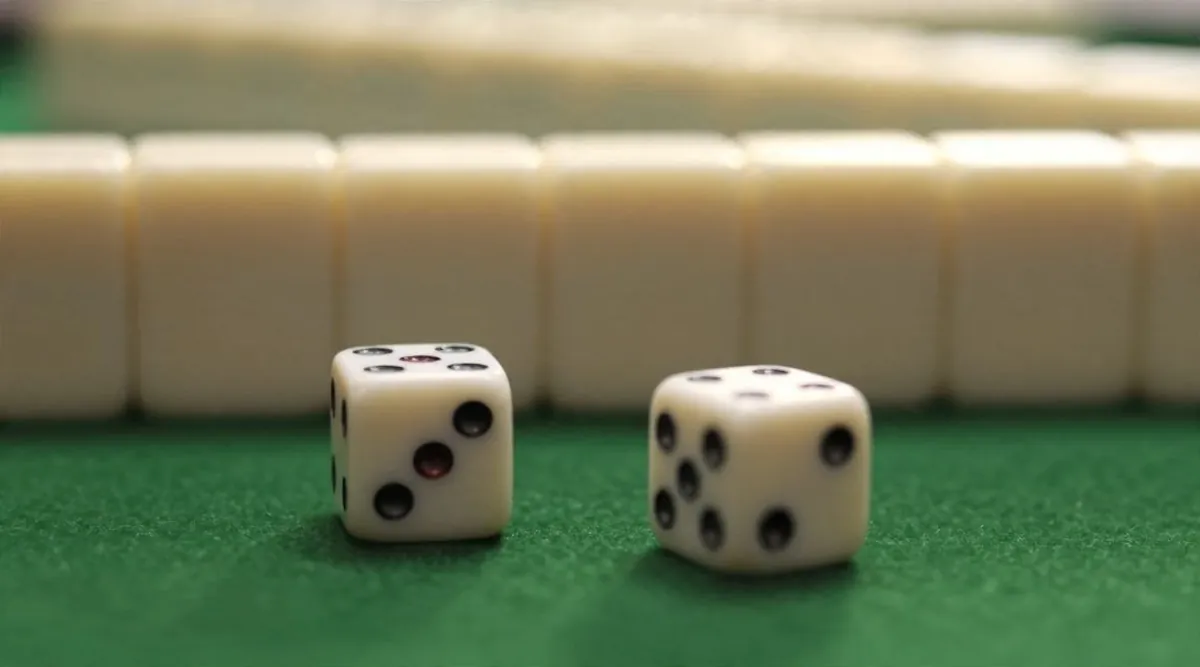
- East rolls the dice to choose where in the wall the deal begins.
- Racked
- A tile is “racked” once it has been placed on a player’s rack, which ends the chance to call the last discard.
Questions people ask
What is a pung, kong and quint in mahjong?
A pung is three identical tiles, a kong is four, and a quint is five. Because a set has only four of each tile, a quint always needs at least one joker.
Why is the White Dragon called Soap?
The White Dragon is often a plain white tile, or a tile with a simple frame, which looks like a bar of soap. In American mahjong it also counts as a zero in year hands.
What does X and C mean on a mahjong card?
X means the hand may be exposed: you can call discards to build it. C means the hand is concealed: only the final winning tile may come from a discard.
What is a hot tile in mahjong?
A hot tile is a tile that would probably give another player Mahjong, judging by their exposures and what has been discarded. Careful players avoid throwing it late in the game.